


“I just remember running and holding my stomach saying ‘this is what it is, this is why I’m running’. I have a few friends with endometriosis, I wanted to do it for them.”
Kirsten Ellis, 30, ran the Hackney half marathon last year to raise awareness for endometriosis, a condition that she suffers from.
Endometriosis
It is a fairly unknown illness but it is the second most common gynaecological condition in the UK.
Last week was Endometriosis Awareness Week with events taking place all over the country lead by the charity, Endometriosis UK.
“I’d heard good things about the Hackney half marathon, and signed up to do it a week after I’d completed the Brands Hatch half marathon, I got the bug,” she says.

Ellis is currently undertaking a part-time Master’s degree in audiological science at UCL in London while also working in a paediatric audiology department.
Diagnosis
“Diagnosis for me was the turning point when I was 20, that’s when they decided to treat me as if I had endometriosis. It was still two years though until the surgery that confirmed it. It was a long and painful two years,” she tells Hackney Post.
Ellis had always had heavy and painful periods since the age of 11 but when she was 15 she started to have sharp pains just above her right hip. Her doctor gave her medication for Irritable Bowel Syndrome (IBS) and sent her home.
“I knew deep down it wasn’t but didn’t know how to articulate it,” she said. “I had crazy abdomen cramps around my period alongside extremely heavy bleeding and then started cramping in between cycles.
“I felt like I didn’t have anyone to tell, and I was tired of bothering my parents with it. PE teachers at school accused me of lying about my periods as I was skipping swimming lessons more regularly than the other girls.”
Pain
Ellis was given contraceptive pills by her doctor who insisted they would help.
“I was still bleeding heavily and passing clots daily – I felt like they were treating the bleeding, but not the pain.”
Shortly after turning 20, she had her first laparoscopy, the only surgical procedure currently able to diagnose endometriosis, but the results didn’t show anything and she was discharged.
After settling down into a comfortable relationship, she found the confidence to talk about her condition to other people. Her now-mother-in-law suspected she may have endometriosis and encouraged her to mention it to her doctor.
“I desperately wanted it to be endometriosis, just so that I had a name for whatever it was causing me so much pain, but also didn’t want it to be.” Like many other women who suffer with endometriosis, Ellis felt frustrated during her ordeal.
“I never really felt like they believed me when I’d tell them the extent of my pain. Almost like I was making it up. Emotionally, that has been difficult to deal with. I’ve cried in appointments more times that I would like to admit.
“I saw a registrar instead of the consulting surgeon and she told me flippantly that I had endometriosis. Almost with the tone that you would use to tell someone that their flies were undone.”
Relationships
Ellis is grateful for her supportive husband, colleagues and friends and she now feels like she has more control over her condition.
“Living with endometriosis is like taming an angry beast. I know what makes it worse, and I know how to soothe it. It tells me if I’m working too hard, or pushing myself physically. It has made me learn to listen to my body. It does get me down, but I don’t let it define me.”
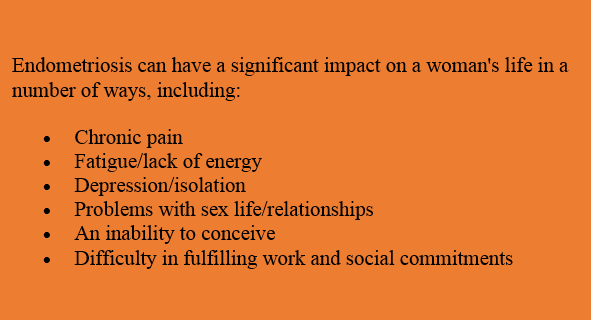
Around 1.5 million women in the UK are living with this condition and it can affect many areas in life from careers to relationships.
Emma Cox, a spokesperson for Endometriosis UK, said: “In terms of encouraging people to reach out to women with endometriosis, I would suggest this should be something everyone does – men as well as women.
“You can help family members, friends, and colleagues with endometriosis by understanding the impact it can have on their lives and supporting them through challenging times they may face. Being understanding if they are not able to do things you had planned, even at the last minute.”
Ellis also has some advice for any other women who may be going through the same pain and are unsure of what to do. She suggests keeping a diary and speaking to the GP, family planning clinic and friends.
“We need to look after our bodies and having to tolerate pain is not normal. If you feel that your enjoyment in life is being affected, please speak to someone. Anyone. If you speak up, you may encourage someone else to, who in turn will encourage one of their friends. We are all in this together.”
The facts
One in 10 women in Britain is affected by the condition where the cells that normally grow in the lining of the uterus grow on the outside of the uterus. Every month the cells go through the standard procedure of building and breaking down. But whereas the cells normally leaves the body as a period, the blood has no way out.
Featured image credit: Kirsten Ellis
Like our page on Facebook, follow us on Twitter or Instagram.


I absolutely adore this woman. She inspires me every day, helps me to laugh through my own pains, and always understands, completely, when (sadly, not “if”) I have to cancel our plans because of endometriosis. I’m fairly certain that she is one of the best people on the planet, if not the Universe.