


The camera follows a solitary man, dressed in a suit, strolling along an empty sea front as the wind blows his tie up into his face. His strides are purposeful but their intention is only revealed once the man – and the camera following him – catch up with a big brass band playing in full swing right at the water’s edge. As the man picks up the conductor’s stick and flails it around passionately, David Rose points to the screen and exclaims: “Watch, watch. Oh, I love this bit! I love the unexpected! What a brilliant bit of film.”
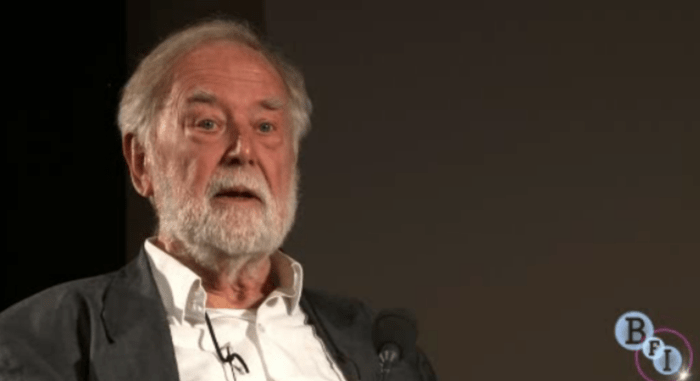
This is David Rose – prolific producer and purveyor of the unexpected. We are sitting in his living room in Hackney watching a scene from a biopic about Rose that will be shown in Hackney pub, The Duke of Wellington, on Tuesday 12 March. The conductor being filmed is Sir Malcolm Arnold CBE, one of the many great men who Rose, now 87, has worked with. It’s a rare treat to have a running commentary from the former BBC head of regional drama, commissioning editor for fiction at Film on Four and recipient of a British Film Institute fellowship. Though Rose’s speech and movements have inevitably slowed with age, his broad smile speaks of his pride in the achievements playing out on the screen in front of us.
Rose built his reputation on surprising the audience and subverting their expectations – he is proud that his production Girl surprised audiences in 1974 by delivering TV’s first lesbian kiss, although he tells me indignantly that many believe it happened in an episode of Brookside in 1994.
In 1985, Rose produced the socially groundbreaking film My Beautiful Laundrette, which kick-started the career of Daniel Day Lewis – now a record-breaking three-time recipient of the Best Actor Oscar. When I ask Rose if he had realised he was working with an actor who would go on to great things, his answer is a flat and unimpressed “no”.
But the unexpected also appeared in Rose’s work in much more subtle ways. Z-Cars, which he produced from 1962-65, was hailed as the first TV drama to depict gritty reality and address social issues. ‘Licking Hitler’ – a television play written by David Hare that Rose admits is one of his favourites – painted the dark world of a black propaganda unit in World War II, at a time when no one had previously shown the brutal reality of the war effort. Rose’s willingness to move away from the conventional pushed the boundaries of the ordinary. “I don’t want to make it easy for the viewer – I don’t like them to know what’s coming,” he said.
Rose started at the BBC, in 1954, as an assistant floor manager in the drama department, eventually moving into producing and directing for the dramatised documentary unit. He was then commissioned to produce Z-Cars and, afterwards, its spin-off Softly, Softly.
It wasn’t until then-managing director of the BBC Huw Wheldon sent Rose up to their Birmingham unit, known as Pebble Mill, that Rose came into his own. He was told to “find talent in the regions and nurture them” – and outstanding talent he found.
“There was a huge gulf between cinema and television when I joined,” says Rose. “The BBC hated film because they’d invested all their money on video and they didn’t want to be faced with the cinema unions. And, of course, cinema hated television because their audiences were dwindling because of it.
“The people we had working in Birmingham – Mike Leigh, Stephen Frears – simply had no access to cinema because there was no crossover then. People say Birmingham was the British film industry in waiting.”
Considering Leigh went on to direct Vera Drake, Happy-Go-Lucky, and Palme d’Or winner Secrets & Lies, while Frears created The Queen, My Beautiful Laundrette and The Grifters, you could certainly say that.
It wasn’t until 1982 when Sir Jeremy Isaacs, head of Channel 4, invited Rose to head up the new Film on Four division that those barriers started to fall away – in part due to Rose breaking them down himself.
“At [Film on Four] we decided that if distributors wanted, they could have the films in the cinemas before television. So although we were television we were generous, in a way, to let the cinemas reap the awards first.”
Rose’s appointment marked a new era of British film – the team at Film on Four produced many films that went on to have global success, including Gangsters, Palme d’Or winner Paris, Texas, and Wish You Were Here.
“And it culminated in that golden egg there,” he says, pointing to the Roberto Rossellini award, given to Channel 4 at Cannes in 1987 for services to cinema. It sits on Rose’s shelf as testament to the role he played in making it all happen.
“So my dreams came true after all those years.”
The documentary on David Rose will be showing at The Duke of Wellington Pub, 119 Balls Pond Road, Hackney on March 12, 7.30pm www.thedukeofwellingtonn1.com.

