

Ben Edwards visits the East End Wrestling School to learn how to become a luchador.
I’m keeled over at my computer googling ‘neck injuries’, convinced I’m suffering from whiplash. The rest of my body feels like it’s been caught in the middle of a Wild West gunfight. The website warned that Mexican wrestling would hurt, but I never imagined it would be as painful as this.
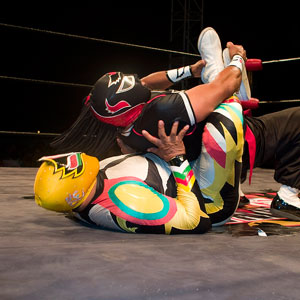
Two wrestlers in the midst of ‘performance.’ Photo: Jerry Keane
Lucha Libre – the art of Mexican wrestling – is technically the same as American wrestling. It’s theatre, not blood sport. Yet what makes Lucha Libre distinctive is the masks. Because no matter how colourful they are, there’s no escaping the fact they look like they’ve been pinched from a Soho sex shop.
This is all I can think about as my instructor Garry Vanderhorne (Shiro Yoshida in Lucha-lingo – a sobriquet which is clearly more Japanese than Mexican) barks orders at me in his little green gimp mask.
Goodies and Baddies
The mask is significant because it’s what gives the wrestler his identity. And because this is theatre, it also determines whether his character is a Tecnicos (the good guy) or a Rudos (the villain). But you don’t get to wear a mask here until you graduate.
It takes months of dedication and practice to become a professional luchador; this is no casual hobby.
“I was doing pro shows after three months, but I was far too inexperienced,” says Garry. “I would say you need at least a year, but the learning process never stops because the art form is always evolving. We’re like professional stunt men, but we only get one chance to get it right.”
Because of the injury risks, building up strong neck muscles is an essential part of becoming a luchador, says Garry. They do this with an exercise I didn’t even know existed – reverse press ups with your head called bridging. Arch your neck back too much, Garry warns, and it will snap.
The illusion of pain
The first lesson is learning how to fall convincingly without hurting yourself. It’s called a back bump, and the trick is to fall on your upper back with your neck tucked in and your hips thrust out while simultaneously slamming your arms down on the floor to create an illusion of pain.
Once we’ve grasped the back bump, the second most important skill for a luchador to master is the front bump. Which, as the name suggests, is falling on your front and making it look like you’ve landed on your face. “You’ve got to sell it,” says Garry, as he sweeps my legs away and I smash my forehead on the floor. “Excellent,” he applauds, as I stagger off in a daze.
This tripping and falling is the closest we get to proper wrestling. We spend the rest of the session learning how to roll out of an imaginary arm lock, which is essentially a roly-poly and something even I can manage. But by now, my body is broken and I’m relieved when we’re finally allowed to limp home.
People often sneer at professional wrestling for being fixed, and I was probably one of them. But as I sit here, bruised and barely able to turn my head sideways, I have learnt a new respect for the sport. I mean, imagine how much agony I would be in if we’d actually done some wrestling.
For more information see – www.luchabritannia.com
