

A loud horn sounds above the busy buzz of traffic followed by a series of yelled expletives. A filthy lorry quickly accelerates away leaving a furiously shouting cyclist surrounded by a cloud of dirty smog.
“It happens all the time,” the angry cyclist explains in a quieter tone, swinging himself off his bike and removing his helmet. He pauses to glare in the direction of the lorry before leaning against a nearby tree.
David James is visibly shaken after the confrontation and it takes a minute before he calms down.
Worryingly this scene is nothing new for the cyclists of Hackney. Each day thousands of the borough’s bikers are involved in near-misses with lorries and other HGVs.
“You’ll be sitting in a queue of traffic next to a lorry and when the cars start moving they just cut right into you without a moment’s hesitation,” the 26-year-old explains.
“The best you can do is try to jump out of the way, yell, scream and try to tell them they could have nearly killed you.
“It’s frustrating and it’s scary but you have to be grateful that you have come out of that confrontation intact. But some people just aren’t as lucky.”
Reminder
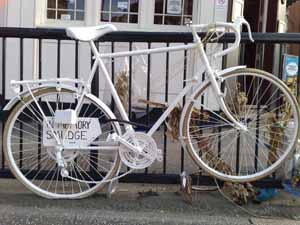
Anthony ‘Smudge’ Smith died in 2008 following a collision with a HGV. Photo: Flickr user D1V1D
Behind David rests a bright white, so-called ‘ghost bike’ strapped to the railings, covered with slowly wilting flowers, brightly coloured decorations and lovingly hand-written messages – an eerily beautiful memorial for a cyclist recently killed in an accident.
“There are too many of these around this borough,” he says quietly. “And too many of them are there because of careless lorry drivers.
“Hackney is especially bad. I’ve been cycling here for years now and it seems like there’s an accident involving a cyclist and a big lorry pretty much every month.
“Surely all of this is clear evidence that something serious needs to be done?”
Charlie Lloyd, cyclist and London Cycling Campaign cycling development officer, believes that cyclists need to be particularly aware of the threat that HGVs and other large vehicles pose.
“There are more dangerous factors in Hackney than in a lot of other places. 20 per cent of people in Hackney cycle at least once a week, and this number keeps increasing.
“There has been a real cycling revolution, particularly in Hackney. But then there are also two of three major lorry routes that go straight through the borough.
“The council have done a lot to prevent lorry drivers from using the smaller, narrower roads, but there is still a huge amount of lorry traffic going through the area that is really dangerous for cyclists.”
Artistic memorial
On 2 February, Daniel Cox was hit by a Mercedes lorry while cycling through Dalston Junction. He died in hospital two days later. An intricately decorated ‘ghost bike’ was constructed in his memory the following week.
The death of the 28-year-old artist sparked outrage among local campaigners, and his family and friends called for the local authorities to take stronger action in the fight against cyclist deaths.
The London Cycling Campaign is currently petitioning for all councils in the capital to introduce training programmes for HGV drivers as part of its No More Lethal Lorries campaign.
Mr Lloyd believes that these schemes will provide drivers with better understanding and guidance on how they can increase the safety of cyclists.
“We are urging councils to get their drivers trained,” Mr Lloyd says. “We want lorry companies to invest in better training and better equipment for their drivers.
“Many companies already provide the best possible equipment and hopefully it will soon be compulsory for the rest to do the same.”
On 9 March, the family of cyclist Eilidh Cairns, who was killed in a collision with a lorry in Notting Hill in February 2009, secured a written declaration on collisions with HGVs from the European Parliament
The Declaration outlines proposals for tougher legislation on HGV safety equipment, calling for all large vehicles to be fitted with cameras and sensors that will eliminate the drivers’ blind spots.
Although this political success represents a victory for cyclists throughout the EU, Mr Lloyd argues that more needs to be done on a local level, before this legislation is put into action.
“It is fantastic that the campaign has reached this stage,” he says. “It is a great success, but this outcome only means that the process will continue. People will take it away and work on it for maybe a year or so. It is by no means immediate.
“What we need is for lorry drivers to act now, to take steps towards increasing cyclist safety as soon as they can.”

[…] This feature was written for the Hackney Post and can also be seen at http://www.hackneypost.co.uk […]